The IRS Smell Test: Three Time Logs That Didn't Survive a Sniff
Tax Court judges aren't forensic accountants. They're people who've written checks and done Saturday chores—and a fake log always fails the test of ordinary life.

There's a persistent fantasy among STR investors that beating an audit is a technical exercise — that if the spreadsheet is formatted well enough, the hours will stand. The case law says otherwise. Judges don't run forensics on your log. They read it the way a person reads it, holding it up against the one dataset they know cold: what everyday life actually looks like. That's the smell test, and it has ended more material participation claims than any statute. Three logs, three distinct odors.
Smell #1: The log that changed its story
In Manalo, the taxpayers came to court with a calendar and an original log. When those didn't clear the 100-hour bar, they introduced three revised logs at trial — including a last-minute reconstruction of the husband's hours. The court found the revisions uncorroborated and unreliable, and the claim failed. The tell here isn't any single entry; it's the editions. A true record doesn't need a second draft, and every revision is an admission that the first version wasn't a record at all — it was an opening offer.
Smell #2: The log that flunks the kitchen test
In Escalante, the taxpayer's log claimed hundreds of hours for writing checks and reviewing mortgage statements. The court's response was devastating precisely because it wasn't technical: the judges considered how long it takes to write a check, based on their own experience of daily life. That's the whole analysis. Everyone in that courtroom had written a check. Nobody needed an expert witness to know it doesn't take hundreds of hours a year. When your log asks a judge to believe something their own kitchen table contradicts, the log loses.
Smell #3: The log that's too clean
In Pourmirzaie, the log showed the taxpayer at her rentals every single Saturday, performing "weekly cleaning and repairing" — identical entry, week after week, like a metronome. It reads as diligent. It smells like fabrication. Real life has lumps in it — the missed weekend, the flu week, the Saturday the car wouldn't start. A log with no stinky sock in it anywhere is a log somebody laundered. This is the counterintuitive one, because it's the pattern people think looks most credible: perfect regularity is what you produce when you're inventing the past, not recording the present.
What all three share
None of these logs died on the law. They died on plausibility — rewritten history, impossible hours, suspicious perfection. The judges did what any experienced person does with a story that's a little too tidy: they sniffed it. And a fabricated log always fails that test, because fabrication optimizes for what the writer thinks looks good, while reality optimizes for nothing.
Which points to the only log with no smell at all: the one you didn't write. A record built from system timestamps, exact call durations, and third parties on the line has no editions to revise, no hours a judge can disbelieve from personal experience, and all the natural irregularity of actual work — because it is the actual work. EvidenceGraph builds that record automatically: every management call recorded, transcribed, and time-stamped as it happens, with real life's fingerprints all over it.
You can't fake the lumps. Fortunately, you don't have to.
EvidenceGraph provides documentation tools, not tax or legal advice. Consult your CPA or tax attorney regarding your specific situation.
Frequently asked questions
- What is the “smell test” for IRS time logs?
- It’s the plausibility review judges and examiners apply to a time log — reading it against ordinary experience rather than running technical forensics. Courts have rejected logs with rewritten entries, impossible hours, and suspiciously perfect patterns because they fail basic believability, regardless of formatting.
- Can I revise or update my time log before an audit or trial?
- Revising a log is one of the strongest signals against you. In Manalo, taxpayers introduced three revised logs at trial, including a last-minute reconstruction, and the court found them uncorroborated and unreliable. A contemporaneous record doesn’t need editions — every revision suggests the original was never a real record.
- How do judges decide if my claimed hours are believable?
- Often by comparing them to their own everyday experience. In Escalante, the court evaluated hundreds of hours claimed for writing checks by considering how long the task actually takes in daily life. Hours that contradict common experience get rejected without any need for expert analysis.
- My log shows the same work every week — does consistency help my case?
- Perfect consistency can hurt you. In Pourmirzaie, a log showing identical “weekly cleaning and repairing” entries every single Saturday was not credited. Real schedules have gaps and irregularities; a log with none reads as reconstructed rather than recorded.
- What makes a time log survive the smell test?
- Natural irregularity anchored to independent evidence. A credible log varies the way real life varies, and its entries cross-reference records you didn’t create — call logs with exact durations, invoices, booking data, messages. Plausibility plus corroboration is the combination courts consistently credit.
- What kind of participation record can’t be faked?
- One generated by systems and third parties rather than written by you. Recorded management calls carry system timestamps, exact durations, and a counterparty on the line — with all the natural variation of actual work. That record has no revisions, no implausible hours, and nothing for a judge to sniff at.
Related posts
 Recordkeeping
The Hours You Didn't Log Are the Hours You Didn't Work
Two owners, identical work, identical hours—but one kept a contemporaneous log and one reconstructed it in April. In a substantiation fight they are not in the same place. Part 3 of the §469 Problem Series.
 Audit Defense
Two Taxpayers Walked Into Tax Court. Only One Had Phone Records.
What a pair of §469 cases reveals about the evidence that actually wins a material participation fight—and the evidence that doesn't exist when you need it.
 Audit Defense
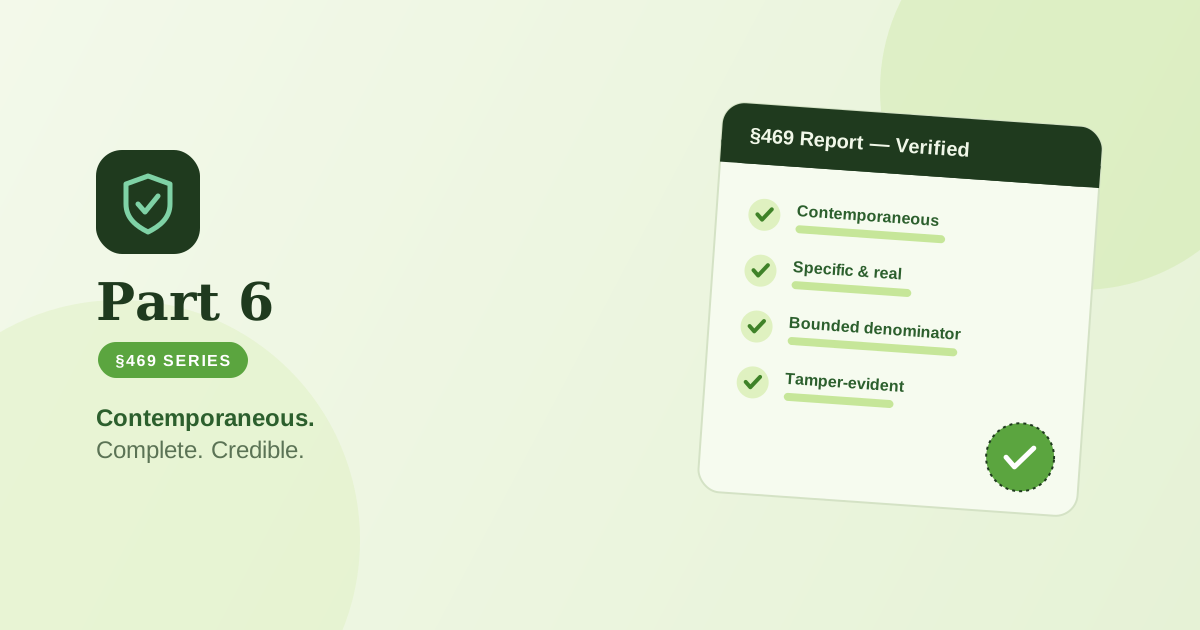
What Audit-Defensible Actually Looks Like
The four marks of a defensible position—contemporaneous, specific, bounded denominator, tamper-evident—and why a spreadsheet can't produce them. The series conclusion. Part 6 of the §469 Problem Series.