Two Taxpayers Walked Into Tax Court. Only One Had Phone Records.
What a pair of §469 cases reveals about the evidence that actually wins a material participation fight—and the evidence that doesn't exist when you need it.
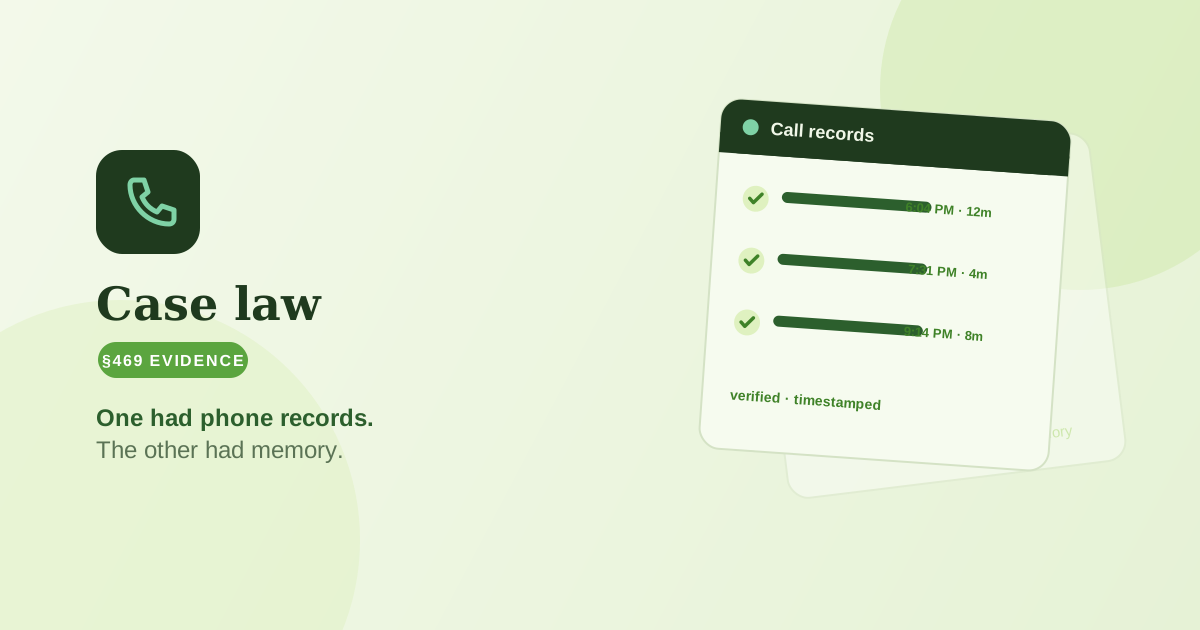
Nobody plans to lose a material participation case. The taxpayers who lose them genuinely did the work — that's what makes these cases painful to read. They managed the properties, made the calls, coordinated the vendors. Then the IRS asked them to prove it, and they discovered that memory isn't evidence.
The hardest-working man in Tax Court
Consider a taxpayer we'll call the hardest-working man in Tax Court. In Senty, the record showed a man who worked 65 to 70 hours every week across his businesses. He did business the old-fashioned way — face-to-face meetings and phone calls, rarely email. When the IRS challenged his participation, he had his own memory, his son's memory, and nothing else. No phone records. No documentation. The court called his hours "ballpark estimates" and ruled against him — not because he didn't do the work, but because he couldn't substantiate it.
Now flip the record
In Tolin v. Commissioner, the taxpayer faced the same challenge: prove your hours or lose your losses. He produced contemporaneous telephone records and credit card statements. The court found that objective evidence sufficient to corroborate his narrative of the work he performed — and he won. Same story in Lamas: phone records plus credible testimony carried the day.
Read enough of these cases and the pattern stops being subtle. Courts don't reject time logs because they're imperfect. They reject them because nothing in them can be independently verified. A spreadsheet says whatever you typed into it. A phone record says what actually happened — a system-generated timestamp, an exact duration, and a third party on the other end of the line.
"Reasonable means" has a floor
The IRS's own regulations allow "any reasonable means" of proving participation. That sounds generous until you see what courts have done with it: calendars reconstructed a year after the fact drew a 20% accuracy penalty on top of the disallowed losses (Almquist). Logs assigning identical time estimates to every task — 7 hours of cleaning whether the guest stayed one night or fourteen — got thrown out wholesale in a 2025 short-term rental case (Mirch). "Reasonable means" has a floor, and the floor is contemporaneous, specific, and verifiable.
The evidence you're already generating
Here's the part most STR investors miss: the evidence that wins these cases is a byproduct of work you're already doing. Every call to a cleaner, a contractor, a co-host, or a manager is a timestamped, third-party-corroborated record of your participation — if it's captured. The taxpayer in Senty ran his businesses by phone and had nothing to show for it. His phone was generating winning evidence every day. Nobody was keeping it.
That's the problem EvidenceGraph was built to solve. A dedicated number per property. Every management call recorded, transcribed, and time-stamped automatically. The decisions you made, extracted into an audit-ready record — not reconstructed in March from a calendar and a prayer, but accumulated in real time, the only way courts consistently credit.
You don't get to choose whether the IRS asks the question. You only get to choose what you're holding when they do.
EvidenceGraph provides documentation tools, not tax or legal advice. Consult your CPA or tax attorney regarding your specific situation.
Frequently asked questions
- What evidence does the IRS accept to prove material participation?
- Any “reasonable means” — but courts have consistently required contemporaneous, verifiable records, not memory. Tax Court decisions have credited phone records, credit card statements, emails, and third-party corroboration, while rejecting after-the-fact reconstructions as “ballpark guesstimates.” The safest evidence carries a timestamp you didn’t create yourself.
- Is a spreadsheet time log enough to survive an IRS audit?
- Usually not on its own. A spreadsheet only says what you typed into it; courts look for objective corroboration — records generated by a system or a third party. A log becomes credible when its entries can be cross-checked against phone records, receipts, invoices, or booking data.
- What is a “ballpark guesstimate” and why do courts reject it?
- It’s the Tax Court’s term for hours estimated after the fact rather than recorded as they happened. In Almquist v. Commissioner, a calendar reconstructed roughly a year later was rejected as a guesstimate — and the taxpayers were hit with a 20% accuracy penalty on top of the disallowed losses.
- Do phone calls count toward material participation hours?
- Yes — calls managing your rental (coordinating vendors, cleaners, contractors, guests) are participation, and phone records are among the strongest evidence courts have accepted. In Tolin v. Commissioner, telephone records corroborating the taxpayer’s narrative helped win the case; in Senty, a taxpayer who worked primarily by phone lost because he kept no records of it.
- I use a property manager or co-host — can I still prove material participation?
- Possibly, but you must document their hours as well as yours. In Pohoski v. Commissioner, taxpayers lost partly because they offered no evidence of the management company’s time. Under the 100-hour test, you’re compared against each other individual — so a record showing who made the decisions on every call is evidence for you, not against you.
- Can I reconstruct my time log at tax time from calendars and bank statements?
- You can, but it’s the weakest position to be in. Courts have repeatedly rejected reconstructed and revised logs — including logs introduced at trial in Manalo v. Commissioner — as uncorroborated. Records created contemporaneously, as the work happens, are what the case law consistently rewards.
Related posts
 Recordkeeping
The Hours You Didn't Log Are the Hours You Didn't Work
Two owners, identical work, identical hours—but one kept a contemporaneous log and one reconstructed it in April. In a substantiation fight they are not in the same place. Part 3 of the §469 Problem Series.
 Audit Defense
What Audit-Defensible Actually Looks Like
The four marks of a defensible position—contemporaneous, specific, bounded denominator, tamper-evident—and why a spreadsheet can't produce them. The series conclusion. Part 6 of the §469 Problem Series.
 Short Term Rentals
The 100-Hour Test Compares People, Not Companies
Full-service managers assume they disqualify their owners from the STR loophole. The regulation says something different — and proving it requires zero change to how you run your business.