You Bought It Remote. Can You Still Win the Hours?
The best STR markets are rarely where you live, and the obvious fix—a full-service manager—can quietly destroy the whole benefit. The way through is separating labor from participation. Part 5 of the §469 Problem Series.
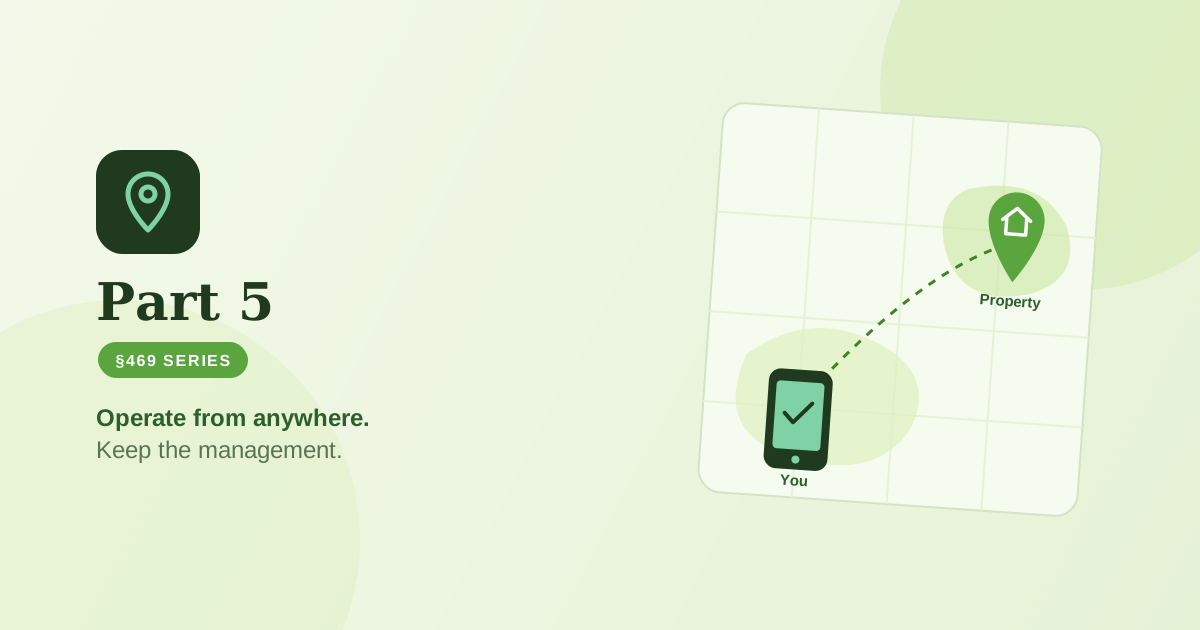
Part 5 of 6 — The §469 Problem Series
This is the question that quietly kills the most short-term-rental tax strategies, and it's the one the loophole pitch almost never addresses honestly: what if the property isn't near you?
The best STR markets for a tax-motivated buyer are often nowhere near where the buyer lives. A high earner in California, a doctor in New York, an executive in a high-tax metro — the math that makes the strategy work points them toward properties hundreds or thousands of miles away. So they buy remote. And then they run straight into §469's central demand: you have to materially participate. From there.
Can you? The honest answer is: yes, but the structure has to be right, and the most natural-seeming version is a trap.
The trap: hand it to a manager
The obvious move when you own a property far away is to hire a full-service property manager. They handle everything. You collect checks. Clean and simple.
And it can quietly destroy the entire tax benefit.
Material participation rewards your involvement. A full-service manager who runs the property is, in participation terms, a single individual pouring in hundreds of hours — almost certainly more than you, and very possibly enough to make the activity "managed by someone else" rather than by you. Hire the manager, and you may have bought yourself convenience and lost the non-passive treatment that was the whole reason for the strategy. The depreciation still exists; it just may no longer touch your active income.
So the reflex that makes remote ownership feel manageable is exactly the reflex that can disqualify you. That's the trap.
The real question: labor vs. participation
The way through is a distinction most owners never draw: separate the labor from the participation.
You don't have to do the physical work to materially participate. You have to do the managing — the decisions, the coordination, the judgment calls — and you have to be the one whose involvement exceeds any other single person's, or who clears 500 hours outright. Physical labor can be hired out. Management is what has to stay yours.
That means the remote owner's job isn't to fly out and clean toilets. It's to be the genuine operator from wherever they are: setting and adjusting pricing, making the booking and stay decisions, communicating with guests, dispatching and approving vendors, issuing access credentials, handling problems, deciding what gets fixed and by whom. All of that can be done from a phone three states away. All of it is real participation. And all of it can be logged as it happens.
The vendors, meanwhile, do the labor — and per the last post, you keep them split across multiple individuals so no single one out-participates you. Labor distributed; management concentrated in you. That's the shape of a remote position that holds.
The honest limit
I'm not going to tell you this scales infinitely, because it doesn't. There's a real ceiling, and a good advisor will tell you where yours is.
At some number of remote doors, the genuine management work exceeds what one person can actually do and honestly log — and at that point you either bring in help that starts competing with your own hours, or you cap the portfolio, or you accept that some properties become passive. The 500-hour test buys headroom (about ten hours a week of real management across a grouped portfolio is achievable for a while), but it's not bottomless. Anyone who tells you that you can own thirty remote properties and materially participate in all of them, by yourself, forever, is selling something.
The truthful version is narrower and more useful: a remote owner can materially participate across a meaningful number of doors — if the labor is hired and split, the management genuinely stays theirs, and the hours are captured as they happen. The strategy works remotely. It just doesn't work passively, and "remote" and "passive" are not the same word, even though the manager pitch tries to make them so.
What this demands
Stack up everything the last four posts established, now under remote conditions, and the requirement is specific:
You need to perform real management acts from a distance — and capture each one, contemporaneously, with its timestamp and substance. You need every vendor tracked as a separate individual with running hours, kept split so none dominates. You need to see, in real time, whether you're still winning the comparison or clearing 500. And you need all of it to live in one place, because a remote operator juggling a personal phone, a separate spreadsheet, and three cleaners' invoices will not sustain the discipline past February.
In other words, the remote case doesn't introduce a new requirement — it makes the existing ones non-negotiable. What you could maybe fake with a local property and a good memory, you cannot fake from a thousand miles away. Remote ownership is where loose documentation goes to die, and where a system that captures participation as a byproduct of operating becomes the only thing that actually works.
That system is what the final post is about. We've spent five posts deepening the problem: the proof is missing, it's an hours test, the timing is the credibility, the vendors are the hidden denominator, and remote ownership makes all of it mandatory. Now let's look at what audit-defensible actually looks like — and the platform built to produce it.
Next in the series: What Audit-Defensible Actually Looks Like.
This series is educational and not tax or legal advice. Remote material participation is highly fact-specific — whether your structure qualifies must be confirmed by your CPA.
Frequently asked questions
- Can I materially participate in a short-term rental I own remotely?
- Yes, material participation is about hours and involvement, not physical proximity. Remote owners can accumulate qualifying hours through guest communication, pricing and listing management, vendor coordination, bookkeeping tied to operations, and remote problem-solving. The challenge is volume and documentation, not location.
- Can I use the STR loophole if I have a property manager?
- Yes, but it requires structuring. Under the 500-hour test you can qualify regardless of the manager’s hours. Under the 100-hour test, your participation must be not less than the manager’s, so you must track both. A full-service manager handling everything while the owner claims material participation is a recognized audit red flag.
- What remote activities count toward material participation?
- Activities that count include guest communication, adjusting pricing, managing the listing, coordinating and directing vendors, handling bookings, and operational record-keeping. Purely investor-capacity work, such as reviewing financials without managerial involvement, does not count. The work must reflect genuine day-to-day operational involvement.
- Is there a limit to how far remote management scales for material participation?
- In practice, yes. The more you delegate to a full-service manager, the harder it becomes to show your hours are not less than that manager’s under the 100-hour test, and the harder it is to reach 500 hours per property. Material participation has an honest ceiling that tightens as you add doors and outsource operations.
Related posts
 Material Participation
Your Cleaner Might Be Disqualifying You
Under the 100-hour test your competition isn't everyone combined—it's the single person who did the most, usually the cleaner. The fix changes the denominator, and it's just good operations. Part 4 of the §469 Problem Series.
 Audit Defense
What Audit-Defensible Actually Looks Like
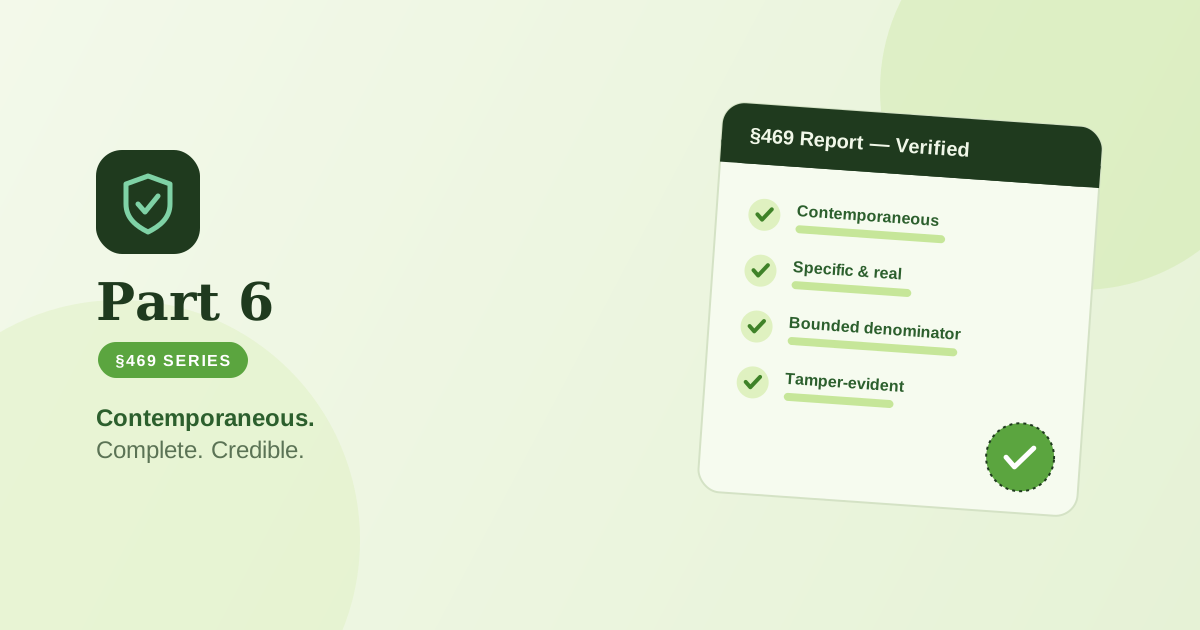
The four marks of a defensible position—contemporaneous, specific, bounded denominator, tamper-evident—and why a spreadsheet can't produce them. The series conclusion. Part 6 of the §469 Problem Series.
 Short Term Rentals
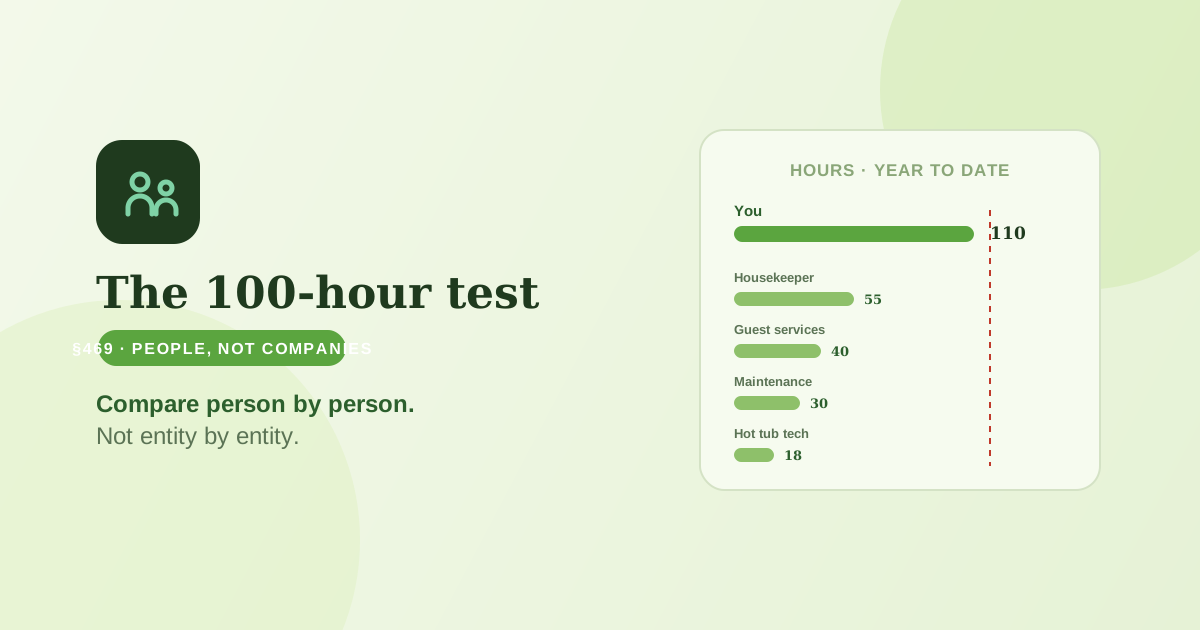
The 100-Hour Test Compares People, Not Companies
Full-service managers assume they disqualify their owners from the STR loophole. The regulation says something different — and proving it requires zero change to how you run your business.