Your Cleaner Might Be Disqualifying You
Under the 100-hour test your competition isn't everyone combined—it's the single person who did the most, usually the cleaner. The fix changes the denominator, and it's just good operations. Part 4 of the §469 Problem Series.
Part 4 of 6 — The §469 Problem Series
We left the last post with a warning: a perfect record of your own hours doesn't save you if you're relying on the 100-hour test and someone else worked more than you did. Today we look that problem in the eye, because it has a name, a number, and — fortunately — a fix that's also just good operations.
The math nobody runs until it's too late
Go back to the 100-hour test: you need 100+ hours and more participation than any other single individual. The phrase that matters is "any other single individual." Your competition isn't the sum of everyone who touched the property. It's whichever one person did the most.
For most short-term rentals, that one person is the cleaner.
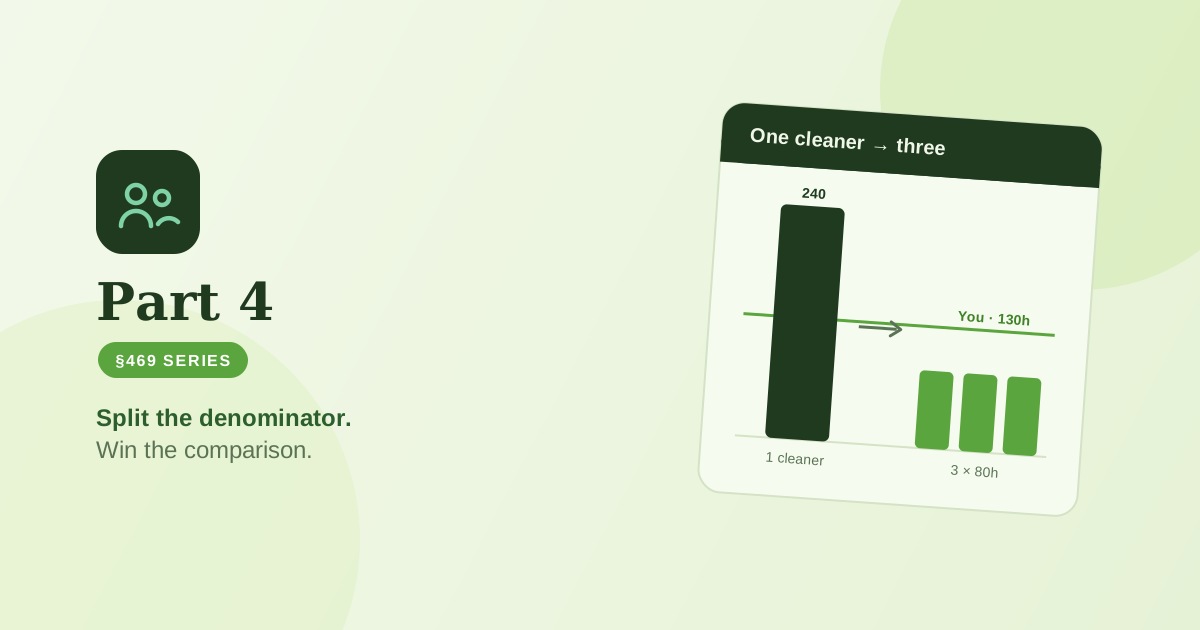
Run the numbers honestly. A couples-oriented STR booked at reasonable occupancy might turn over 80 times a year. If your cleaner spends three hours per turn — clean, linens, restock, reset — that's 240 hours. If you, the owner, logged 130 hours of genuine management, you are not close. One individual participated nearly twice as much as you. Under the 100-hour test, you fail, and your 130 real hours don't change it.
This is the quiet disqualifier. Not a mistake in your logging. Not a lack of effort. Just arithmetic you never ran, working against you in the background all year.
Two ways out, and only one of them is good
Option one: out-work the cleaner. Log more than 240 hours yourself. Possible, but for a single remote-ish property it often means padding — and we covered in the last post why padded hours hurt more than they help. Trying to manufacture 250 honest hours on one small unit usually produces a log that looks exactly as invented as it is.
Option two: change the denominator. This is the real fix, and it turns on a detail of the test most people miss. The comparison is against any one individual — not against all your vendors combined. So if no single person dominates the hours, you don't have to out-work the total. You only have to out-work the largest single contributor.
Split the cleaning across three independent cleaners instead of one, and those 240 hours become roughly 80 hours each. Suddenly the largest single competing individual is at 80 hours — and your 130 genuine hours clear it comfortably. You didn't work more. You changed who you had to beat.
Why this isn't a gimmick
Here's the part that makes this defensible rather than clever: spreading cleaning across multiple contractors is what a well-run remote property does anyway.
One cleaner is a single point of failure. They get sick. They get busy. They double-book your Saturday turnover with someone else's. They get sloppy in month nine. They raise rates, or quit mid-season. An owner managing remotely with one cleaner is one bad weekend away from a one-star review and a scramble. A rotating bench of three is operational resilience — the kind of redundancy any serious operator builds on purpose.
The tax benefit — a denominator no single individual dominates — falls out of a decision you'd make for pure business reasons. That's exactly the kind of fact pattern that holds up: the business rationale exists independent of the tax rationale. You're not splitting cleaners to game §469. You're splitting them because depending on one person to run your turns is a bad way to run a property, and the participation math happens to reward the prudent choice.
But now you have a tracking problem
Notice what the fix requires. To know you're winning the comparison, you have to know each individual's running hours — not as a vague sense, but as live, maintained totals. You need to be able to say, at any point in the year: my largest single competitor is at 74 hours; I'm at 130. And you need to catch it in real time if one cleaner starts creeping up because the other two flaked, because that's the moment your position quietly slips.
That's not something you eyeball. It's a real-time, multi-party measurement: every vendor tracked as a distinct individual, every visit logged with its hours, the largest competitor always visible against your own total. Do it on a spreadsheet and you'll update it twice in January and never again — and find out at tax time that one cleaner ran away with the hours back in August.
The system this implies
So the requirement has grown. It's no longer just "log my hours contemporaneously." It's "track every participating individual's hours, keep the denominator split, and surface the moment any single person approaches my total." That's a live orchestration problem, not a recordkeeping chore.
This is precisely what EvidenceGraph is built to do on the vendor side: treat each cleaner, handyman, and contractor as a tracked individual with a running total, keep the work distributed so no one person dominates, and flag — in real time — when someone is creeping toward your hours. The same system that documents your participation also bounds everyone else's, which is the only way the 100-hour test is safe to rely on across a real operating year.
There's still one more hard case to face, and it's the one that breaks the most deals: the owner who bought the property in another state and is trying to materially participate from a thousand miles away. Can that even work? Next post.
Next in the series: You Bought It Remote. Can You Still Win the Hours?
This series is educational and not tax or legal advice. Whether multiple vendors are treated as separate individuals, and how the participation comparison applies to your facts, are questions for your CPA.
Frequently asked questions
- Do cleaning hours count against me for material participation?
- Under the 100-hour test, hours worked by your cleaner count toward the comparison of whether anyone else participated more than you. If a cleaning crew accumulates more hours on the activity than you do, you can fail the 100-hour test even if you personally worked well over 100 hours. The 500-hour test does not require this comparison.
- Does a cleaner's company or its individual employees count?
- The comparison is to other individuals’ participation. It matters whether the hours belong to one individual or are spread across a company’s separate employees, because the test looks at whether any single individual participated more than you. Tracking who did what, and for how long, is what makes this determinable.
- How do I keep a cleaner from disqualifying my STR deduction?
- Two honest approaches: rely on the 500-hour test, which has no more-than-anyone-else comparison, or under the 100-hour test, ensure and document that your own participation exceeds any single other individual’s. Some owners also retain tasks such as guest communication, pricing, and vendor coordination to build their own hours. Documentation of everyone’s hours is what proves it.
- Does using a cleaning service automatically disqualify the STR loophole?
- No. Using cleaners does not by itself disqualify you. It only creates risk under the 100-hour test if a single individual’s cleaning hours exceed yours. With the 500-hour test, or with documented owner participation that exceeds any other individual, a cleaning service is fully compatible with material participation.
Related posts
 Recordkeeping
The Hours You Didn't Log Are the Hours You Didn't Work
Two owners, identical work, identical hours—but one kept a contemporaneous log and one reconstructed it in April. In a substantiation fight they are not in the same place. Part 3 of the §469 Problem Series.
 Short Term Rentals
You Bought It Remote. Can You Still Win the Hours?
The best STR markets are rarely where you live, and the obvious fix—a full-service manager—can quietly destroy the whole benefit. The way through is separating labor from participation. Part 5 of the §469 Problem Series.
 Short Term Rentals
The 100-Hour Test Compares People, Not Companies
Full-service managers assume they disqualify their owners from the STR loophole. The regulation says something different — and proving it requires zero change to how you run your business.